
Understanding Connections vs Tools
Connections
Connections
Connections are what you add to AI models - they link WonkaChat to your business systems like Outlook, Slack, or Google Drive.
Tools
Tools
Tools are the individual capabilities within each connection. For example, an Outlook connection might include tools for reading emails, sending messages, and managing calendar events.
Before You Start
Check Your Access
Ensure you have login credentials for the business system you want to connect (e.g., your Outlook email and password).
Know Your Permissions
You’ll only be able to access data in connected business systems that you already have permission to view or edit.
Video Walkthrough
Watch this step-by-step guide to see the entire connection process in action:Step-by-Step Connection Process
1
Locate the MCP Panel
In your WonkaChat interface, find the MCP Settings on the right side of the screen. This panel displays all available business system connections.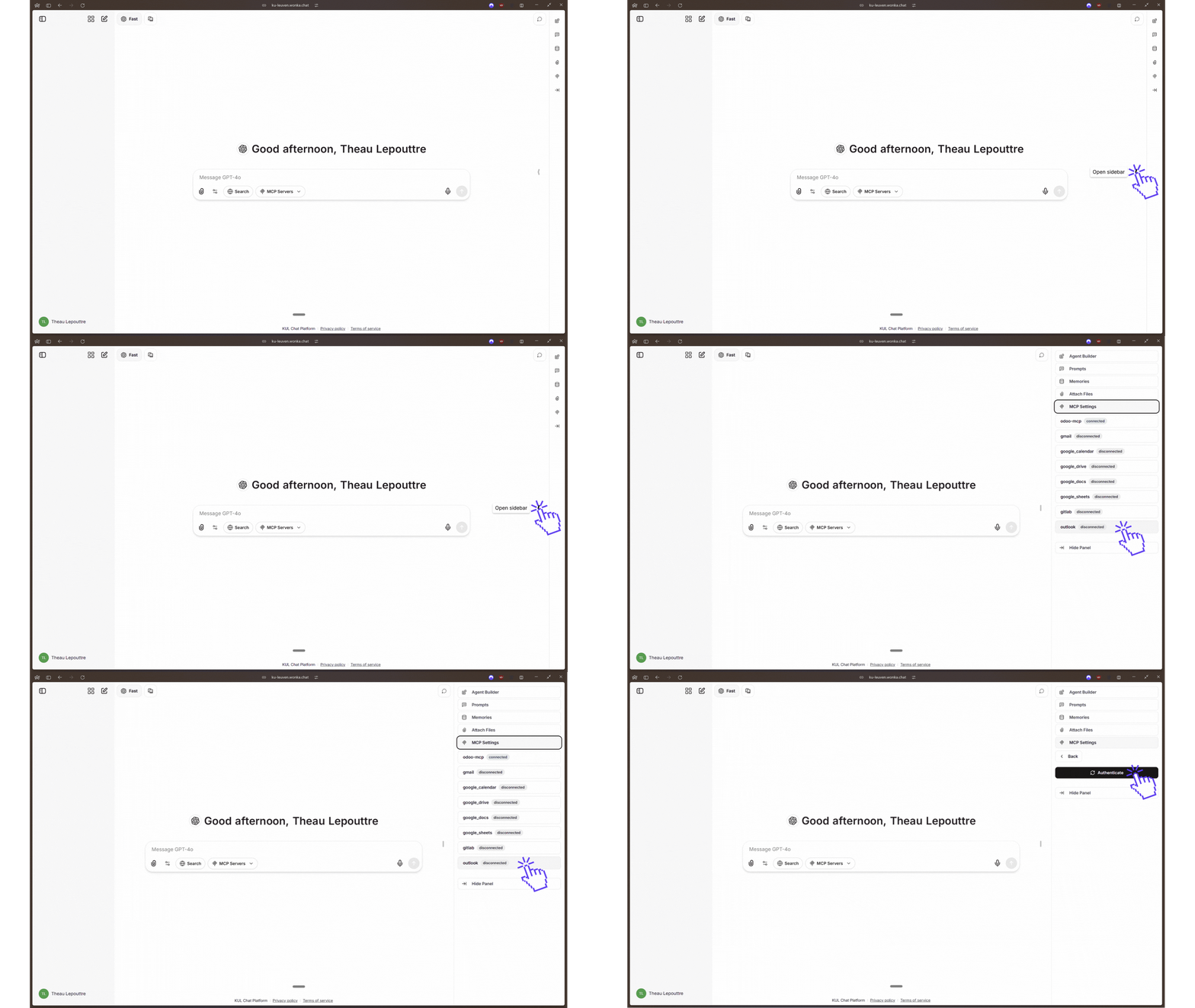
MCP panel and Outlook connection example
2
Select Your Connection
Browse or search for the connection you want to add. Click the connection’s button to begin the connection process.Popular first connections:
- Outlook or Gmail for email and calendar access
- Slack for team communication
- Google Drive or OneDrive for document access
Not sure which tool to connect first? Start with your email provider, it’s the most versatile connection for daily tasks.
3
Authenticate Your Account
A credential window will appear, requesting authentication for the selected business system. The process varies slightly by connection type:
- OAuth
- API Key
- Custom
Use OAuth authentication for tools like Outlook, Gmail, Google Drive, and most major cloud platforms.
- Click “Initialize”.
- You’ll be redirected to the tool’s official login page.
- Enter your credentials on the tool’s secure site.
- You’ll be automatically redirected back to WonkaChat.
4
Enable The Connection
After successful authentication, you need to activate the MCP connection for the AI model you’re using.
- Click the “MCP Servers” button under the chat input field
- Find your business system in the list
- Click on it to enable the connection for the current chat
Once enabled, the AI model can access this business system whenever you ask it to. You can enable or disable connections at any time.
5
Test Your Connection
Verify the connection is working by asking the AI a simple question that requires the business system.If the AI successfully retrieves and displays information, your connection is working correctly!
Example For Email (Outlook/Gmail):
Connection successful! You can now use natural language to access and interact with this business system through WonkaChat.
6
Disable A Connection
To remove a connection:
- Click the “MCP Servers” button under the chat input field
- Find your business system in the list
- Click on it to disable the connection for the current chat by removing it from the selected connections
Understanding Permissions and Actions
What Can WonkaChat Access?
What Can WonkaChat Access?
WonkaChat can only access:
- Data you personally have permission to view in the connected business system
- Information you explicitly ask it to retrieve
- Resources within your organizational boundaries (if applicable)
- Access data from other users unless they’ve shared it with you
- Bypass your business system’s permission system
- Read or modify data without your explicit request
What Actions Can WonkaChat Perform?
What Actions Can WonkaChat Perform?
WonkaChat’s capabilities depend entirely on what the MCP server implements for each business system. If a provider exposes an action through their MCP server, the AI can perform it. If an action isn’t implemented in the MCP server, the AI cannot access it, regardless of whether the underlying business system supports it.Common capabilities include:Important: The AI model is restricted to only the actions that the MCP server exposes. Even if a business system’s native interface supports a feature, WonkaChat can only use it if the corresponding MCP server has implemented that capability.All actions require your explicit instruction through conversation. WonkaChat only performs actions when you ask it to.
- Read: View emails, documents, tasks, calendar events, database records, etc.
- Write: Send emails, create tasks, update records, schedule meetings, add comments
- Delete: Remove items, archive records, clear data (only when you explicitly ask)
- Search: Query across documents, find specific records, filter data
- Execute: Run workflows, trigger automations, perform calculations
Each MCP server defines its own set of available actions. Check the specific business system’s documentation to see what operations are supported through its MCP implementation.
How Are Credentials Stored?
How Are Credentials Stored?
Your authentication tokens are:
- Encrypted at rest in our secure database
- Unique to your user account (never shared with others)
- Automatically refreshed to maintain connection
- Deleted immediately when you disconnect a business system
Multiple Platform Workflows
Once you’ve connected several business systems, you can combine them in powerful ways:Cross-Platform Queries
Ask questions that span multiple business systems in one request.Example: “Check my Google Calendar for availability and send those times to Sarah via Outlook.”
Data Transfer
Move information between business systems without manual copy-paste.Example: “Take the action items from this Slack thread and create tasks in ClickUp.”
Automated Workflows
Build agents that monitor one business system and take actions in another.Example: Agent that checks Salesforce for new leads and creates follow-up tasks in Asana.
Unified Reporting
Combine data from multiple sources for comprehensive insights.Example: “Summarize my week: emails from Outlook, meetings from Calendar, and completed tasks from Notion.”
Best Practices
Start with Essential Connections
Start with Essential Connections
Connect your most-used business systems first:
- Email (Outlook or Gmail)
- Calendar (Google Calendar or Cal.com)
- Primary project management tool
- Main document storage
Test Before Complex Workflows
Test Before Complex Workflows
After connecting a business system:
- Ask simple queries first to verify it works
- Gradually increase complexity
- Understand what data the business system exposes before building workflows
Review Permissions Periodically
Review Permissions Periodically
Every few months:
- Review which business systems are connected
- Disconnect business systems you no longer use
- Verify connections are still active and working
Create AI Agents with Focused Tool Sets
Create AI Agents with Focused Tool Sets
Why This Matters:AI agents with purpose-built business system connections deliver significantly better results than general-purpose setups. When an agent has access only to relevant business systems for its specific task, it:
- Reduces hallucinations by limiting context to what’s actually needed
- Improves accuracy by focusing on domain-specific data sources
- Delivers faster responses with fewer irrelevant tool checks
- Maintains better context within its area of expertise
Sales Agent
Sales Agent
Connect only: Salesforce, HubSpot, Gmail, Calendar
- Focused on customer data and communication
- Won’t accidentally query unrelated developer tools
- Understands sales pipeline context deeply
Development Agent
Development Agent
Connect only: GitHub, GitLab, Linear, Slack
- Specialized in code and project management
- Faster because it’s not checking email or CRM systems
- Better at understanding technical context
Executive Assistant Agent
Executive Assistant Agent
Connect only: Outlook, Google Calendar, Google Drive, Notion
- Dedicated to scheduling and document management
- Won’t accidentally access technical or sales systems
- More reliable for personal productivity tasks
Operations Agent
Operations Agent
Connect only: Odoo, QuickBooks, Airtable, Slack
- Focused on business operations and finance
- Specialized knowledge of operational workflows
- Better at cross-referencing operational data